How to Solve Urban Parking Problems: 5 Smart Solutions That Work
ParkSathi Team
29 May 2026
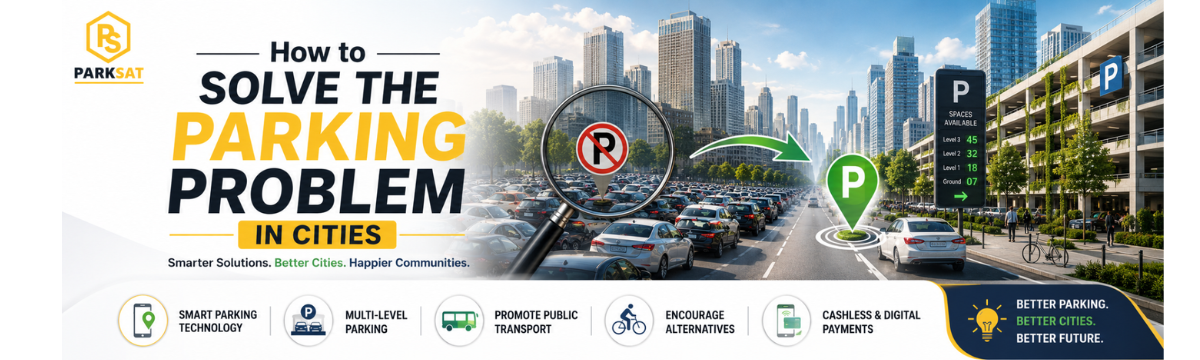
How to Solve the Parking Problem in Cities
Cities are growing fast. More people are moving in every year. And with more people come more cars and far fewer places to park.
Parking has quietly become one of the biggest daily headaches for drivers, residents, and city planners. The problem is not just in big metros. It affects crowded market lanes, busy residential colonies, and commercial hubs everywhere.
So what are the real Parking Problems in cities? And what solutions actually work? Let's break it down.
The 5 Biggest Urban Parking Problems (And Their Smart Solutions)

Problem 1: Existing Parking Spaces Are Wasted
This is the root cause of most parking problems.
The issue is not always that parking doesn't exist. It's that the spaces we have are poorly managed. One area sits empty while drivers circle for 20 minutes in another. Office lots are full on weekdays but empty on weekends. Assigned spots stay vacant all day while visitors have nowhere to park.
This wastes time, fuel, and money for drivers, operators, and the city alike.
Solution: A Parking Management System (PMS)
A PMS collects real-time data on:
Which spots are occupied
How long cars stay parked
When peak hours occur
This helps city planners make smarter decisions. It also enables dynamic pricing, where high-demand spots cost more during rush hours. This naturally pushes drivers toward available spaces elsewhere. The result is better use of existing infrastructure without building a single new spot.
Problem 2: Drivers Waste Too Much Time Finding a Spot
Ask any city driver. Finding parking wastes a huge amount of time.
Studies show drivers in major cities spend 20 to 30 minutes per trip just searching for a parking spot. Multiply that by thousands of drivers every day. That's an enormous waste of time, fuel, and patience.
You're not just late. You're stressed, burning extra fuel, and adding to the very congestion you're stuck in.
Solution: Real-Time Availability via Sensors or Cameras
Cities can place smart sensors in each parking space. These sensors detect whether a spot is free or taken. Cameras can also monitor full lots, covering up to 200 spots per camera.
This live data is then shown on:
A mobile app
An online portal
Digital boards at lot entrances
Drivers know where to go before they even arrive. No more guessing. No more circling. Less traffic. Less stress.
Problem 3: Congestion Inside Lots Causes Pollution and Accidents
This problem is easy to overlook, but it's serious.
When drivers can't find a spot quickly inside a large underground garage or multi-level lot, they keep driving around. Poor signs, low visibility, and no live information make things worse.
The result:
More fuel burned inside the lot
Higher CO2 emissions
Frustrated drivers who take risks
More minor accidents and vehicle damage
Solution: Smart Display Boards Inside the Lot
Install parking display boards at key points: at the entrance, at every aisle, at every row. These boards show how many spots are free in each section, updated in real time.
When a driver sees "Row C has 4 spots available," they go straight there. This small change cuts internal congestion, lowers emissions, and makes parking safer and smoother.
Problem 4: Outdated Payment Systems Slow Everything Down
Many parking lots still use outdated payment methods. Cash booths. Coin meters. SMS systems where you have to guess your exit time.
Overstay by 5 minutes? You get a fine. Leave 45 minutes early? You lose money. These systems are slow, rigid, and frustrating.
Solution: App-Based and QR Code Payments
Modern automated payment systems let drivers pay through a mobile app or by scanning a QR code at their spot. The biggest advantage? You pay only for the time you actually use. Leave early, pay less. No coins. No guessing. No fines.
For lot operators, the benefits are just as clear:
Less cash to handle
Lower operating costs
Better usage data for planning
Problem 5: Parking Areas Have No Safety or Security
Security in parking lots is a serious and often overlooked concern.
Poorly lit areas, no monitoring, and no access control make parking lots easy targets for theft and vandalism. Drivers have no way to know their vehicle is safe.
In dense colonies, the problem goes further. Disputes over occupied spots, vehicle damage, and unauthorised parking regularly turn into serious community conflicts.
Solution: ANPR Cameras and Access Control Systems
ANPR stands for Automatic Number Plate Recognition. Cameras placed at entry and exit points record every vehicle entering and leaving the lot. This creates a full log of who was where and when, which is a powerful deterrent against theft.
Combined with automated gates, these systems ensure only authorised vehicles can enter. Residents can register their plates. Visitors need explicit permission. The result is a safer, more controlled parking experience for everyone.
Other Ways to Reduce Parking Problems

Smart technology works best when paired with other approaches.
Ride-Sharing Services Every car taken off the road through apps like Uber, Ola, or Rapido means one fewer vehicle competing for parking. As more people share rides, demand for parking drops naturally.
Shared Parking Platforms Private parking owners in apartments, offices, or malls can rent out unused spots during off-hours. An office lot that sits empty every evening can serve nearby residents overnight.
Better Public Transport The most sustainable long-term fix is fewer cars on the road. Cities that invest in metro lines, bus rapid transit, and last-mile connectivity reduce car dependency. Fewer cars means fewer parking problems.
Resident Parking Permit Systems In dense residential zones, permit systems assign a fixed number of spaces per household and limit visitor parking to specific zones and time windows. This removes informal disputes and makes colony parking far less tense.
Frequently Asked Questions (FAQ)
Q1. What is the main cause of urban parking problems?
The biggest cause is poor management of existing spaces, not necessarily a shortage of them. Spaces sit unused in one area while drivers circle endlessly in another.
Q2. How does a Parking Management System (PMS) help?
A PMS uses real-time data to track occupancy, peak hours, and usage patterns. It helps operators adjust pricing, redirect traffic, and make better decisions, all without building new parking.
Q3. What is ANPR and how does it improve parking security?
ANPR (Automatic Number Plate Recognition) cameras record every vehicle entering and leaving a lot. This deters theft, prevents unauthorised parking, and gives communities a full log of vehicle activity.
Q4. Can app-based payments really reduce parking congestion?
Yes. Faster payments mean faster entry and exit. Less time spent at booths means shorter queues and smoother traffic flow at parking entrances.
Q5. What is the most cost-effective first step a city can take?
Installing real-time display boards inside existing lots is one of the most affordable and immediately impactful changes. It requires no major infrastructure and visibly reduces internal congestion within days.
Q6. How does ride-sharing reduce parking demand?
Each shared ride replaces at least one private car trip. Fewer cars on the road means fewer cars looking for parking. Over time, this significantly reduces pressure on urban parking infrastructure.
Q7. Are these solutions only for large cities?
No. These solutions scale for cities of all sizes. Even a mid-sized town with a busy market area can benefit from sensors, display boards, and app-based payments.
Final Thoughts
The parking problem in cities is real, common, and growing. But it is absolutely solvable.
Each of the five major parking problems has a proven smart solution:
Wasted spaces → Parking Management Systems
Time lost searching → Real-time sensors and availability apps
Congestion inside lots → Smart display boards
Outdated payments → App and QR code payment systems
Poor security → ANPR cameras and access control
Cities that adopt these solutions have seen real improvements: less congestion, lower emissions, happier drivers, and fewer community conflicts.
With the right mix of technology, policy, and cooperation, every city can make parking easier, fairer, and less frustrating for everyone.